Fun Does Not Need Finality: Blockchain Game Design with Cyberbrawl on Stellar
Cyberbrawl: Expanding the Horizons of Litemint.io
Cyberbrawl, the sequel and rebranding of Litemint.io, is almost here, and it’s loaded with awesome new content and features that take the existing experience to a new level! Here’s a sneak peek at what’s on the horizon.
Seamless Transition for Existing Players
Since 2021, more than 155,000 player accounts have been created on Litemint.io, engaging in over 6 million battles! The game blockchain-related features are opt-in, enabling gameplay directly from mainstream gaming portals. While most players still hold their assets on our servers, there are over 3,200 trustlines to our game assets on the Stellar blockchain and 6% of our players have now linked a Stellar wallet to their profile.
The Tiniest Smart Contract: 65 Bytes Stellar Contract
Anatomy of a Stellar-powered Auction on Litemint
This post breaks down the mechanics behind Litemint’s decentralized NFT auctions on Stellar.
We have just released the Auctions feature on Litemint! NFT owners on Litemint can now run live, time-limited auctions with reserve price to further engage with their potential buyers. Collections also accept a dynamic filter for your auctions.
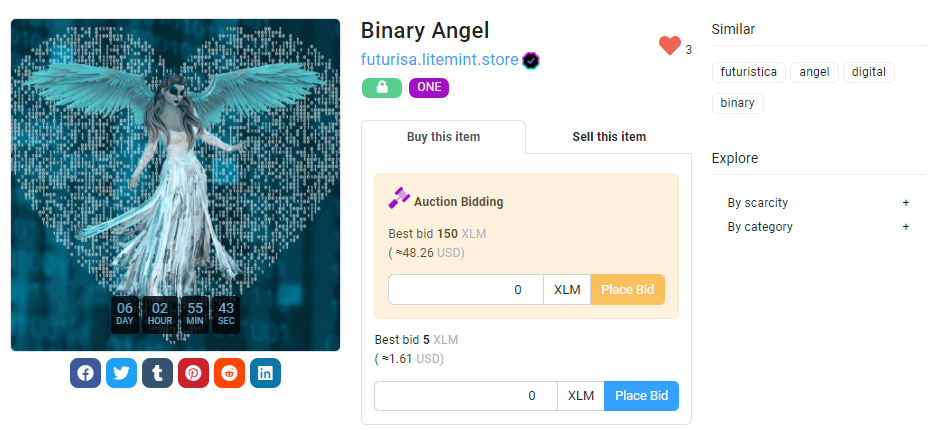
Live auction on Litemint
Litemint auctions are fully decentralized, require no escrow, with full settlement on the Stellar DEX. Let’s uncover the tools and dissect how it works.
NFT Ownership During The Apocalypse
All you need is basic math to prove NFT ownership when everything else is down.
Introduction
I recently shared NFT minting guidelines to help future-proof NFT ownership by using decentralized storage for the art and by creating a circular reference to the asset on the blockchain (i.e. Stellar in our case) using a metadata file. These best practices eventually became the foundation for SEP-0039.
In this short article, we will take a doomsday scenario to illustrate the importance of following these guidelines.
NFT on Stellar – Solution to Pricing Limitations on the SDEX
This post explains the Stellar DEX pricing limitation for indivisible tokens and the solution we use on the Litemint NFT marketplace.
Issuing Indivisible Tokens on Stellar
The smallest amount for an asset issued on Stellar is called a stroop and is equal to one ten-millionth or 0.0000001. Therefore, we can issue 1 stroop of an asset to ensure that it is indivisible (e.g. as part of the requirements for NFTs).
Stellar DEX Price Limit
However, such small amounts may cause issues on the Stellar DEX because Stellar Core internally uses INT32 (see Stellar-ledger-entries.x) for the fractional representation of prices and the INT32 type can only store values between -2,147,483,648 to 2,147,483,647 (inclusive).